
Closing the Cavity Loophole: Balancing A-Rated Breathers with A-Rated VCLs
Closing the Cavity Loophole: Balancing A-Rated Breathers with A-Rated VCLs
While external cladding and outer breather membranes have rightly faced intense scrutiny under the watch of the Building Safety Regulator, true risk mitigation requires a holistic, whole-system approach within the cavity itself. ITP Technical Manager, Paul Harrison, explains why forward-thinking specifiers must look deeper into the wall buildup—moving past minimum regulatory compliance to advocate for both Euroclass A-rated breather membranes and A-rated Vapour Control Layers (VCLs).
In the wake of sweeping regulatory transformations overseen by the Building Safety Regulator, the construction sector’s approach to high-rise and higher-risk buildings has fundamentally shifted. Compliance is no longer seen as a ceiling to reach, but as a baseline floor to build upon. However, when designing and engineering complex modern facades, focusing safety efforts entirely on the outer face of the building envelope leaves a critical job half-done. True risk mitigation requires looking deeper into the cavity.
Historically, much of the industry’s scrutiny has naturally gravitated toward external cladding and outer breather membranes. Yet, a building envelope functions as an interconnected system. Mitigating fire risk effectively means ensuring that every component within that system—from the exterior weather barrier to the internal lining—is engineered to the highest possible standard of non-combustibility. To achieve a truly resilient, future-proof specification, forward-thinking designers are moving past the minimum regulatory requirements. The next logical step in best practice is the adoption of a fully Euroclass A-rated cavity system, pairing A-rated breather membranes with A-rated Vapour Control Layers (VCLs).
Closing the Cavity Loophole
Under current building regulations in England and Wales, membranes within the external wall construction of higher-risk buildings must meet a minimum fire performance standard of Euroclass B-s3, d0. While a Class B rating indicates a material is “limited-combustible” or has a low contribution to fire, it still possesses a calorific value. In a high-pressure cavity environment, any combustible material can potentially fuel a fire or facilitate its spread.
Best practice dictates that we should mirror the stringent, non-combustible rules imposed on external cladding across the entire internal facade buildup. Specifying a Euroclass A1 or A2-rated breather membrane on the external face of the insulation is an excellent starting point.
However, an external breather membrane only protects one side of the insulation zone. On the inner side of the insulation, protecting the structural frame, sits the Vapour Control Layer (VCL). If an A-rated membrane is specified on the outside, but a standard Class B or lower membrane is used as the VCL on the inside, a safety imbalance is introduced into the cavity wall.
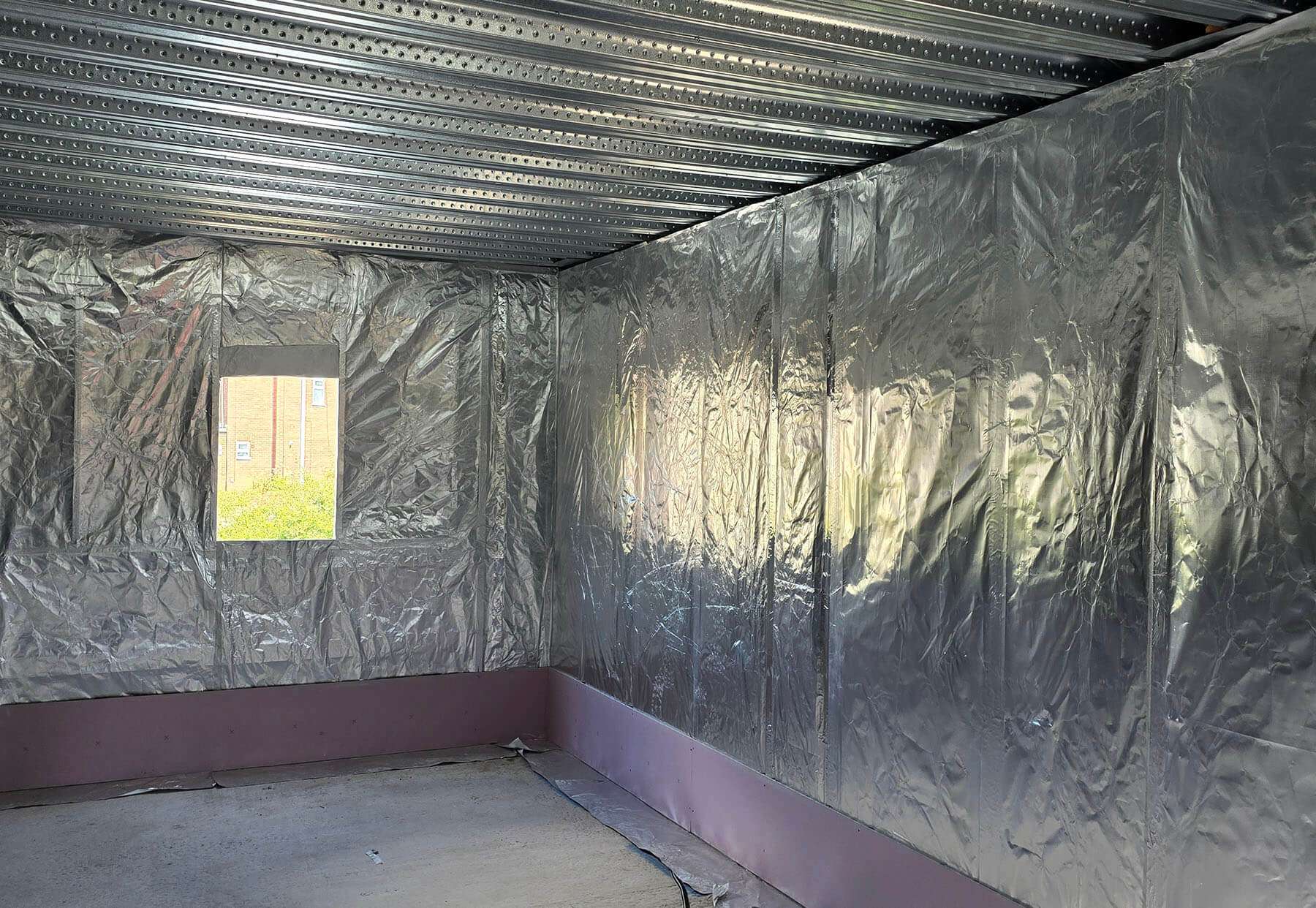
The Double-Sided Shield: Integrating A-Rated VCLs
The primary function of a VCL is to prevent moisture from the internal living spaces of a building from migrating into the insulation and structural wall cavity, where it can cause interstitial condensation, rot, and structural decay. Because VCLs are hidden deep behind internal linings, their contribution to a building’s fire load is easily overlooked.
If a fire breaches the internal wall lining or penetrates the facade cavity, a combustible VCL can act as a hidden pathway for smoke and flame spread. By upgrading the VCL specification to a Euroclass A2-s1, d0 or A1 rating, specifiers effectively create a double-sided fire shield around the insulation layer.
An A-rated VCL ensures that the internal boundary of the cavity is just as robustly protected against fire spread as the external boundary. It guarantees that the material will not contribute to the fire load, will produce virtually no smoke (s1), and will release zero flaming droplets (d0). This holistic approach fundamentally minimises the risk of unforeseen fire performance failure within the hidden areas of the building fabric.
A Whole-System Approach to Specification
Upgrading both sides of the cavity to an A-rating requires a shift in how we evaluate product data. A piecemeal approach to specification is dangerous. Just as with breather membranes, the performance of an A-rated VCL must be scrutinised through a comprehensive, whole-system lens.
When evaluating these materials, specifiers must ensure that the product’s fire classification is backed up by rigorous, independent testing from an authorised testing body. Any fire rated products must be used along with the manufacturer recommended, specified tapes and glues.
Furthermore, moving to an A-rated VCL does not mean compromising on moisture control. High-performance, glass-fibre or foil-core A-rated VCLs are engineered to provide exceptionally low vapour permeability, ensuring robust protection against interstitial condensation while delivering the peace of mind that only non-combustible materials can provide.
Future-Proofing Through Better Choices
The golden thread of building safety demands total transparency, traceable data, and a proactive attitude toward risk management. Relying on minimum regulatory compliance leaves projects vulnerable to future regulatory tightening and, more importantly, misses an opportunity to maximize life safety.
By advocating for and implementing an “All-A-Rated” strategy for both breather membranes and VCLs, the construction industry can eliminate ambiguity within facade cavities. Protecting the building envelope from both sides ensures total peace of mind, delivering a structural fabric that is relentlessly resilient against weather, moisture, and fire for its entire life cycle. For further guidance on fire safety in the building envelope, please contact our Building Team on 01347 825200 or info@itpltd.com